The same order does not need to be typed again before the next system can act.
WORKING SYSTEMS / CHAHUAZE
Start with what is breaking — not the software.
We turn one costly operational friction point into a working, reviewable business state your team can actually use.
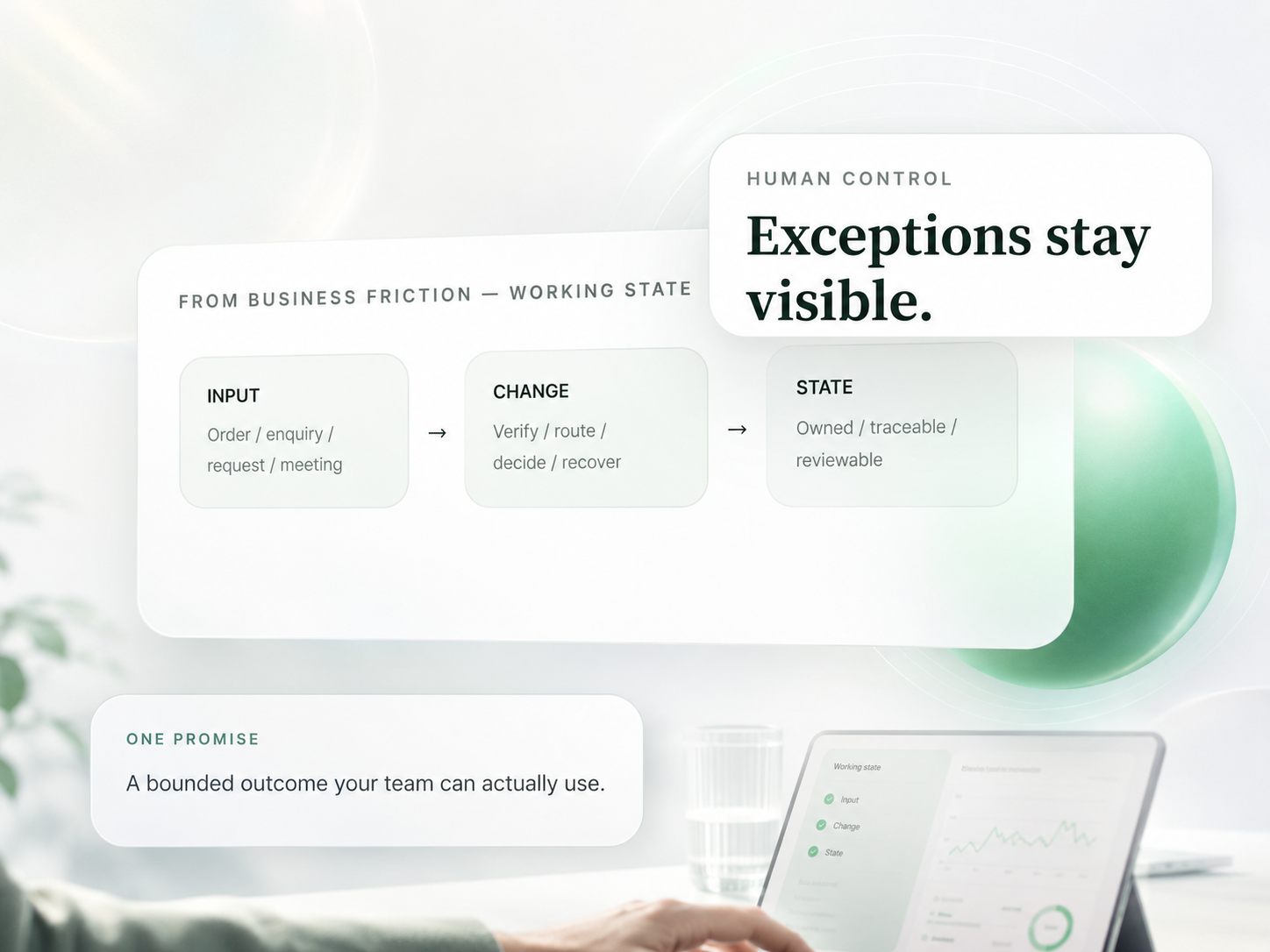
Software stays secondary. The buyer sees the changed business state first.
WHERE IS THE FRICTION HAPPENING?
Four ways into the same question: what needs to work better?
Choose the business moment first. The software, stack and implementation route come later.
Business moment first · implementation route second
01 / MOVE THE WORK
Wholesale Order Flow
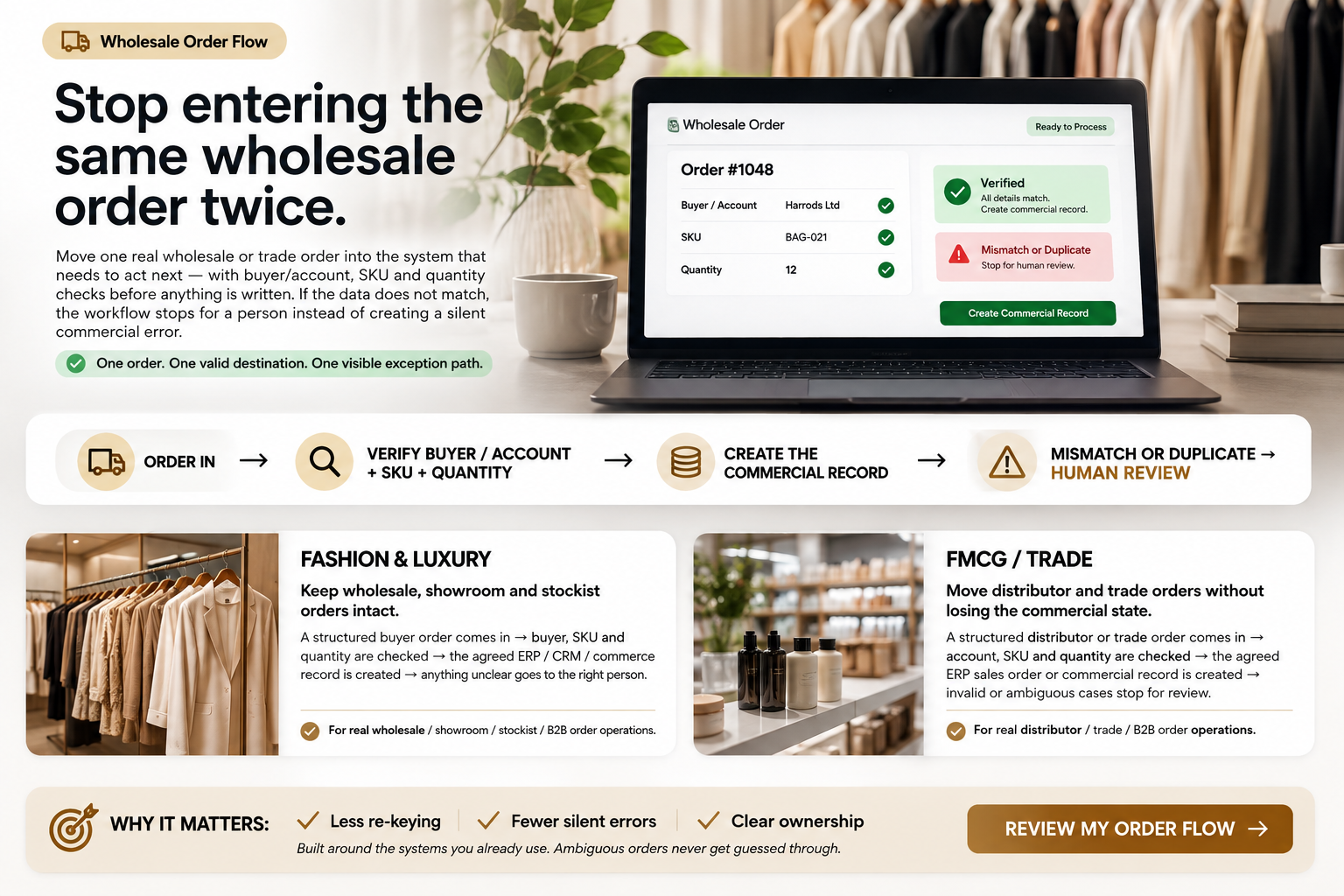
Stop entering the same wholesale order twice.
Move one real wholesale or trade order into the system that needs to act next — with buyer/account, SKU and quantity checks before anything is written.
One order. One valid destination. One visible exception path.
HOW IT WORKS
ORDER IN → VERIFY BUYER / ACCOUNT + SKU + QUANTITY → CREATE THE COMMERCIAL RECORD
CONTROL / FALLBACK
Mismatch or duplicate → HUMAN REVIEW
Invalid, duplicate or ambiguous orders stop before they become a downstream problem.
A bad order has a named exception path instead of disappearing between teams.
HOW IT LOOKS IN YOUR BUSINESS +
FASHION & LUXURY
Keep wholesale, showroom and stockist orders intact.
A structured buyer order comes in → buyer, SKU and quantity are checked → the agreed ERP / CRM / commerce record is created → anything unclear goes to the right person. For real wholesale / showroom / stockist / B2B order operations.
FMCG / BEAUTY
Move distributor and trade orders without losing the commercial state.
A structured distributor or trade order comes in → account, SKU and quantity are checked → the agreed ERP sales order or commercial record is created → invalid or ambiguous cases stop for review. For real distributor / trade / B2B order operations.
Still re-keying wholesale or trade orders between systems?
REVIEW MY ORDER FLOW02 / HANDLE THE CUSTOMER
Commercial Front Desk
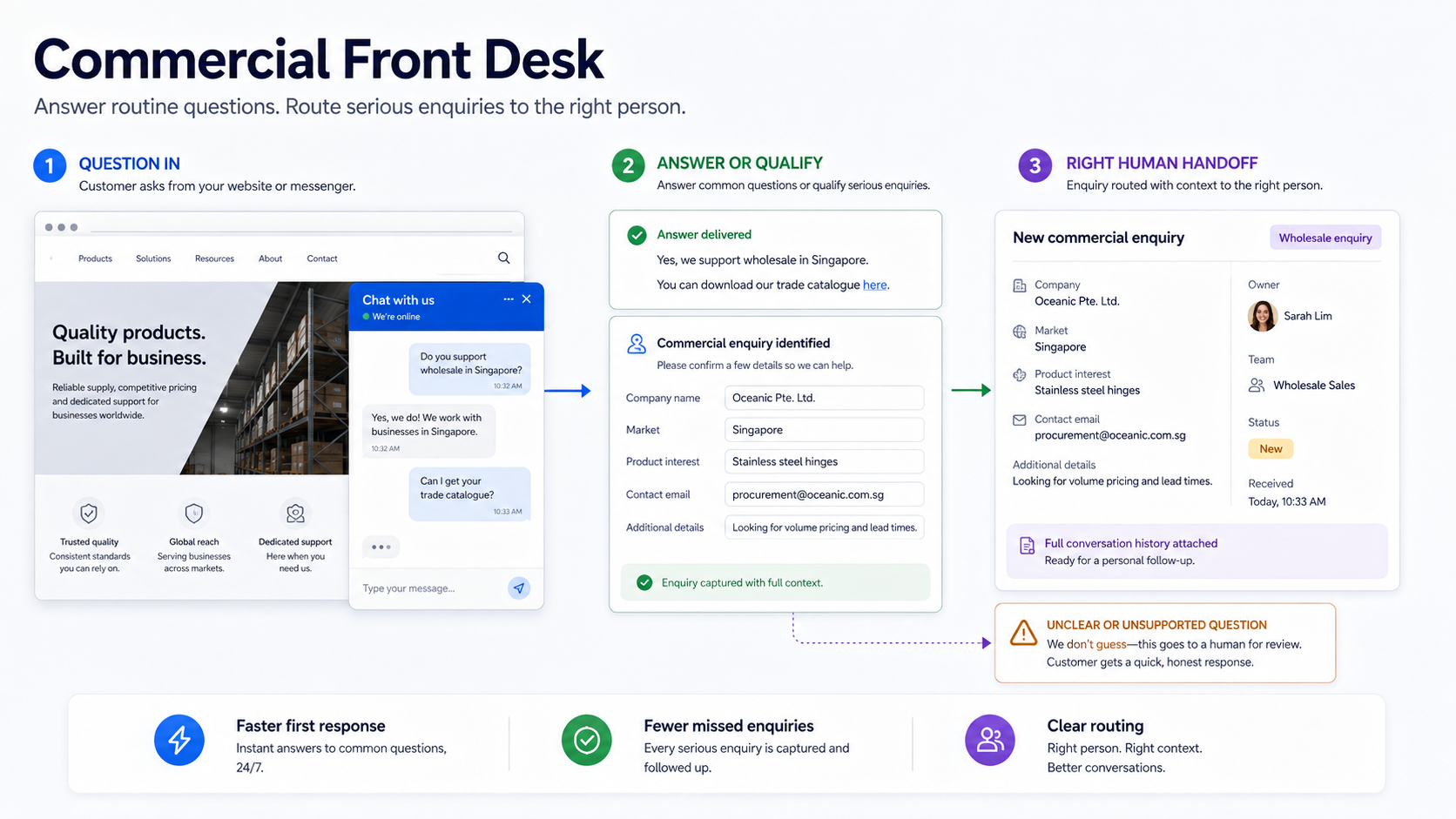
Give every serious enquiry a useful next step.
Known questions get a consistent answer from trusted knowledge. Commercial, specialist or uncertain enquiries collect only the context the next owner needs and reach the right human.
HOW IT WORKS
ENQUIRY IN → RECOGNISE QUESTION / INTENT → ANSWER OR COLLECT CONTEXT → RIGHT OWNER
CONTROL / FALLBACK
Sensitive, uncertain or unsupported question → HUMAN HANDOFF
Repeatable questions stop consuming the same team time again and again.
Serious commercial cases reach a named owner instead of waiting in a general queue.
Useful context travels with the handoff so the customer does not need to start again.
HOW IT LOOKS IN YOUR BUSINESS +
FASHION & LUXURY
Turn one digital front door into the right commercial route.
Wholesale / stockist, product-care, press or partnership enquiries can be recognised, answered where knowledge is approved, or passed to the correct Sales / PR / Partnership owner with useful context. VIP or high-value handling only uses verified client attributes — never tone or guesswork.
FMCG / BEAUTY
Keep repeatable product questions fast and trade enquiries owned.
Approved product / policy questions can be answered consistently. Retailer, trade, wholesale, distribution, press or partnership enquiries collect the minimum useful context and reach the agreed owner. Live stock, retailer inventory, order or account status requires verified connected data.
Serious enquiries still waiting in the wrong queue?
REVIEW MY FRONT DESK04 / SEE WHAT'S HAPPENING
Funnel Leakage Finder
Measure first. Fix second.
Verify one important live journey, find the material drop-off, review representative behaviour and turn the evidence into a ranked fix list and baseline.
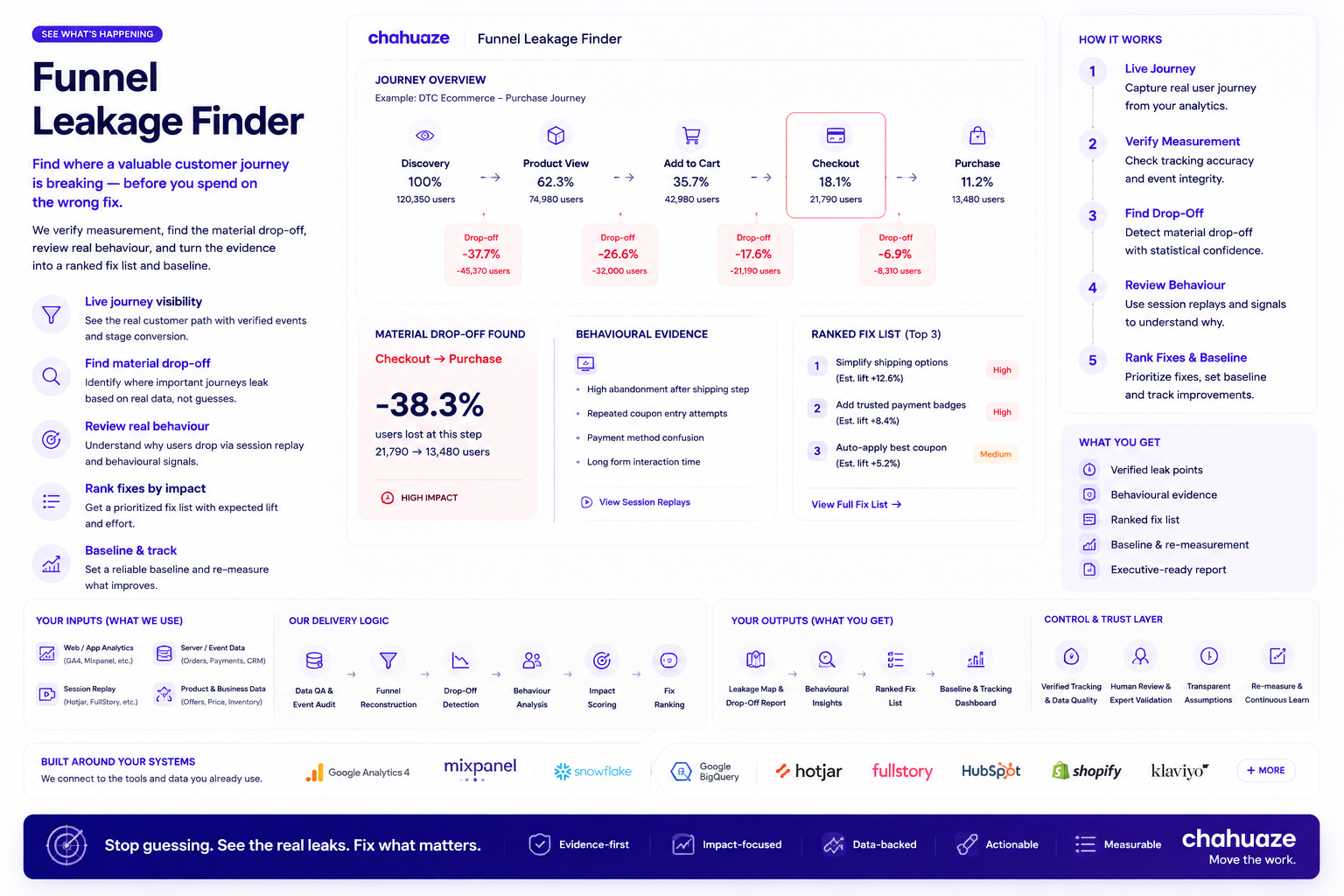
FUNNEL → EVIDENCE → RANKED FIX
HOW IT WORKS
LIVE JOURNEY → VERIFY MEASUREMENT → FIND MATERIAL DROP-OFF → REVIEW BEHAVIOUR → RANK FIXES
CONTROL / FALLBACK
Weak tracking or too little activity → MEASUREMENT READINESS, not a fake diagnosis
The team can see where the material drop-off actually happens.
Representative behaviour around the drop helps separate real friction from guesswork.
The next repair is prioritised by evidence instead of redesign opinion.
HOW IT LOOKS IN YOUR BUSINESS +
FASHION & LUXURY
See where shoppers or wholesale prospects actually stop.
For an owned ecommerce journey: discovery → PDP → cart → checkout → purchase. For a real owned wholesale enquiry flow, measure only the observable steps the brand genuinely controls. Checkout and downstream commercial states must be explicitly measurable — never assumed.
FMCG / BEAUTY
Find the leak in owned DTC or trade journeys before blaming the wrong thing.
For an owned DTC journey: discovery → cart → checkout → purchase. For an owned trade enquiry flow: commercial page → enquiry start → submission → confirmation. Retailer, marketplace or offline purchases stay outside the claim unless a reliable data connection exists.
Stop guessing what to fix next.
FIND MY FUNNEL LEAKAGE05 / HANDLE THE CUSTOMER
Customer Journey Recovery
Start when the moment is real. Stop when the job is done.
A known customer reaches a recoverable moment, enters one controlled journey through an authorised channel, and visibly exits on purchase, success or ineligibility.
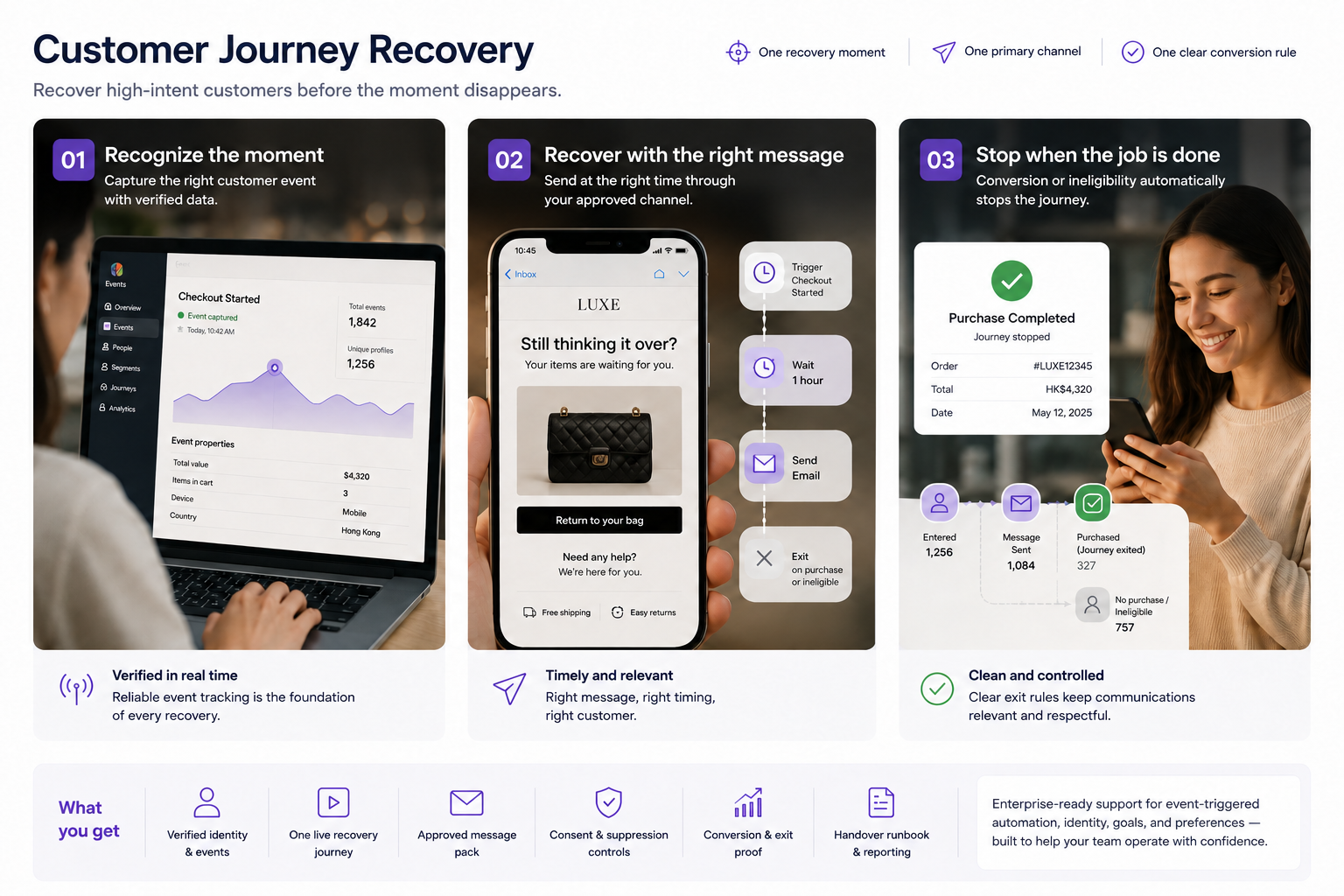
HOW IT WORKS
KNOWN CUSTOMER → VERIFIED TRIGGER → ELIGIBILITY CHECK → APPROVED FOLLOW-UP → PURCHASE / SUCCESS → STOP
CONTROL / FALLBACK
Missing identity, trigger, consent or stop signal → DATA READINESS / HOLD
The journey starts from a real identifiable event, not a vague behavioural guess.
Purchase, success or ineligibility ends the journey under the agreed rule.
Profile, trigger, message and exit state can be checked instead of disappearing into automation.
HOW IT LOOKS IN YOUR BUSINESS +
FASHION & LUXURY
Follow up with known checkout abandoners — and stop after they convert.
For owned ecommerce, an identified customer reaches checkout / cart, does not complete, and enters one bounded recovery journey under real eligibility and stop rules. Back-in-stock or high-value follow-up only comes later when the identity, event and treatment rules are real.
FMCG / BEAUTY
Recover owned DTC checkout moments with the same controlled start-and-stop logic.
For an owned DTC transaction, a known customer can enter checkout recovery. Replenishment / reorder reminders can be a later extension only when product, purchase and communication data genuinely support it. Retailer / marketplace / offline behaviour is not treated as owned recoverable data without a reliable data path.
Do recoverable customer moments currently disappear without follow-up?
REVIEW MY RECOVERY MOMENT03 / MOVE THE WORK
Operations Handoff
The request already exists. The work should not get lost in the handoff.
Capture what matters, match the right record, create or update the agreed next-work object, assign the owner and keep a trace.
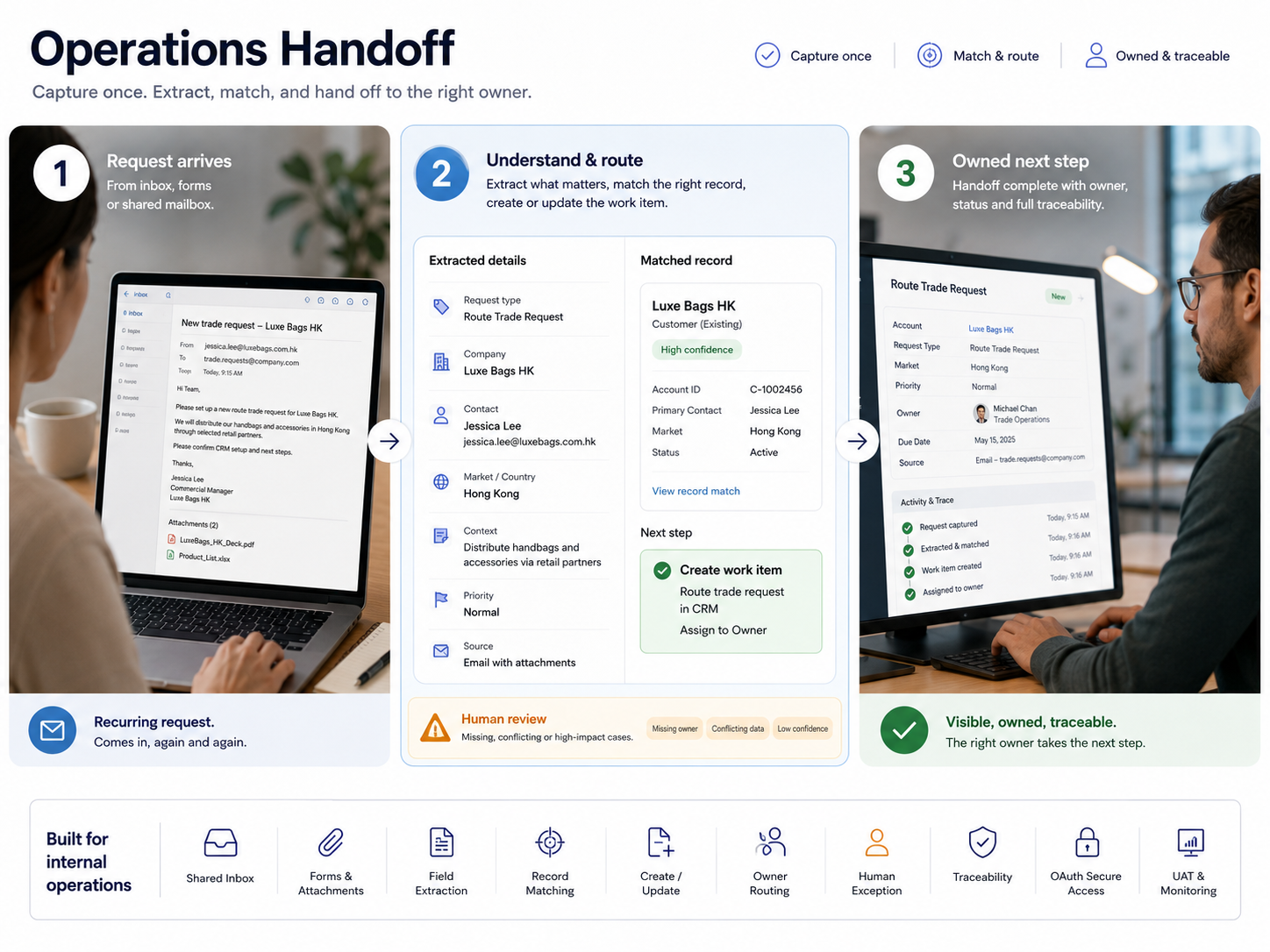
HOW IT WORKS
REQUEST IN → EXTRACT WHAT MATTERS → MATCH EXISTING RECORD → CREATE / UPDATE TRACKED WORK → OWNER
CONTROL / FALLBACK
Missing, conflicting or high-impact case → HUMAN EXCEPTION
People stop reading one tool just to re-key the same request into the next.
The request becomes someone’s visible next action instead of an unowned message.
The source and resulting destination state remain connected and auditable.
HOW IT LOOKS IN YOUR BUSINESS +
FASHION & LUXURY
Turn recurring commercial enquiries into tracked internal work.
A shared commercial inbox can become company / market / request-type context → CRM lookup → the agreed Contact / Company / Task / Note / Deal object → named commercial owner. Use this when the customer-facing conversation is already handled and the internal handoff is the bottleneck.
FMCG / BEAUTY
Route trade, retailer and distributor requests into the system that owns them.
A recurring trade request can become company / market / request-type context → CRM lookup → approved record / follow-up task → named commercial owner. The client’s real CRM, ownership and deal semantics define the route.
Still copying the same request from one tool into another?
REVIEW MY HANDOFF06 / MAKE DECISIONS
Request & Approval Portal
Replace the approval thread with a real system.
Turn one recurring request-and-approval process into a small working portal: a persistent request record, named owner, visible status, explicit human decision path and traceable history.
One request. One owner. One visible decision.
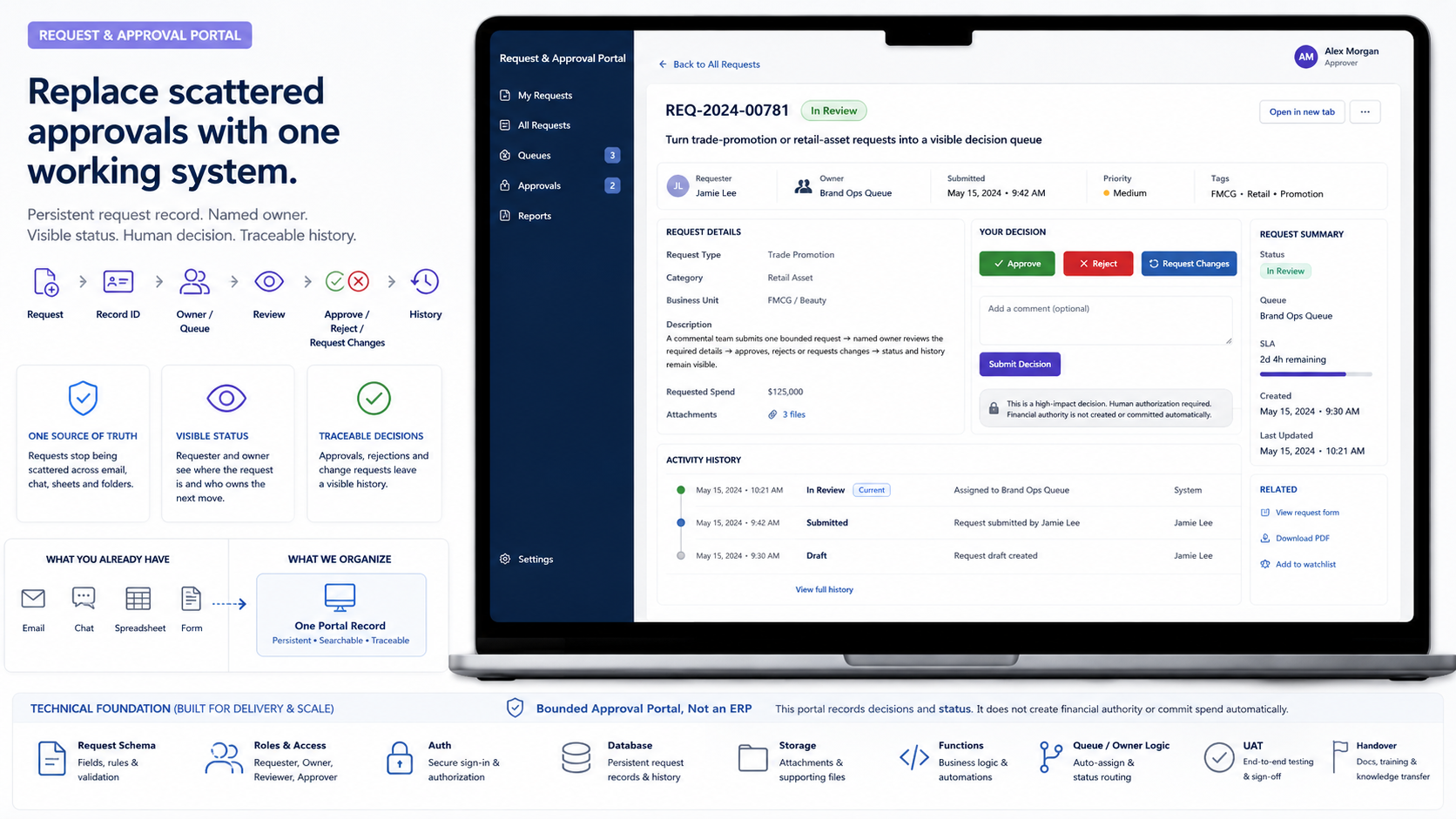
HOW IT WORKS
REQUEST → RECORD ID → OWNER / QUEUE → REVIEW → APPROVE / REJECT / CHANGES → HISTORY
CONTROL / FALLBACK
High-impact legal, brand or spend decision → AUTHORISED HUMAN
The request stops being scattered across email, chat, sheets and folders.
Requester and owner can see where the request is and who owns the next move.
Approvals, rejections and change requests leave a visible history.
HOW IT LOOKS IN YOUR BUSINESS +
FASHION & LUXURY
Give sample, showroom or asset requests a proper home.
A buyer or stylist can submit a sample request with the required details → receive a persistent record → showroom owner reviews → APPROVE / REJECT / REQUEST CHANGES → requester sees status and history. A secondary fit is a bounded VM / store / clienteling asset approval process.
FMCG / BEAUTY
Turn trade-promotion or retail-asset requests into a visible decision queue.
A commercial team submits one bounded request → named owner reviews the required information → approves, rejects or requests changes → status and history remain visible. The portal records the decision; it does not create financial authority or commit spend automatically.
Still running an important approval process through email, chat and spreadsheets?
REVIEW MY REQUEST PROCESS07 / SEE WHAT'S HAPPENING
AI Visibility Audit
Know how AI answers currently see your brand — before you chase isolated prompts.
Compare your brand with the competitors that actually matter, inspect representative AI responses and citations, see which sources shape the category, and turn the evidence into a prioritised visibility-gap backlog you can recheck later.
Evidence before AI visibility tactics.
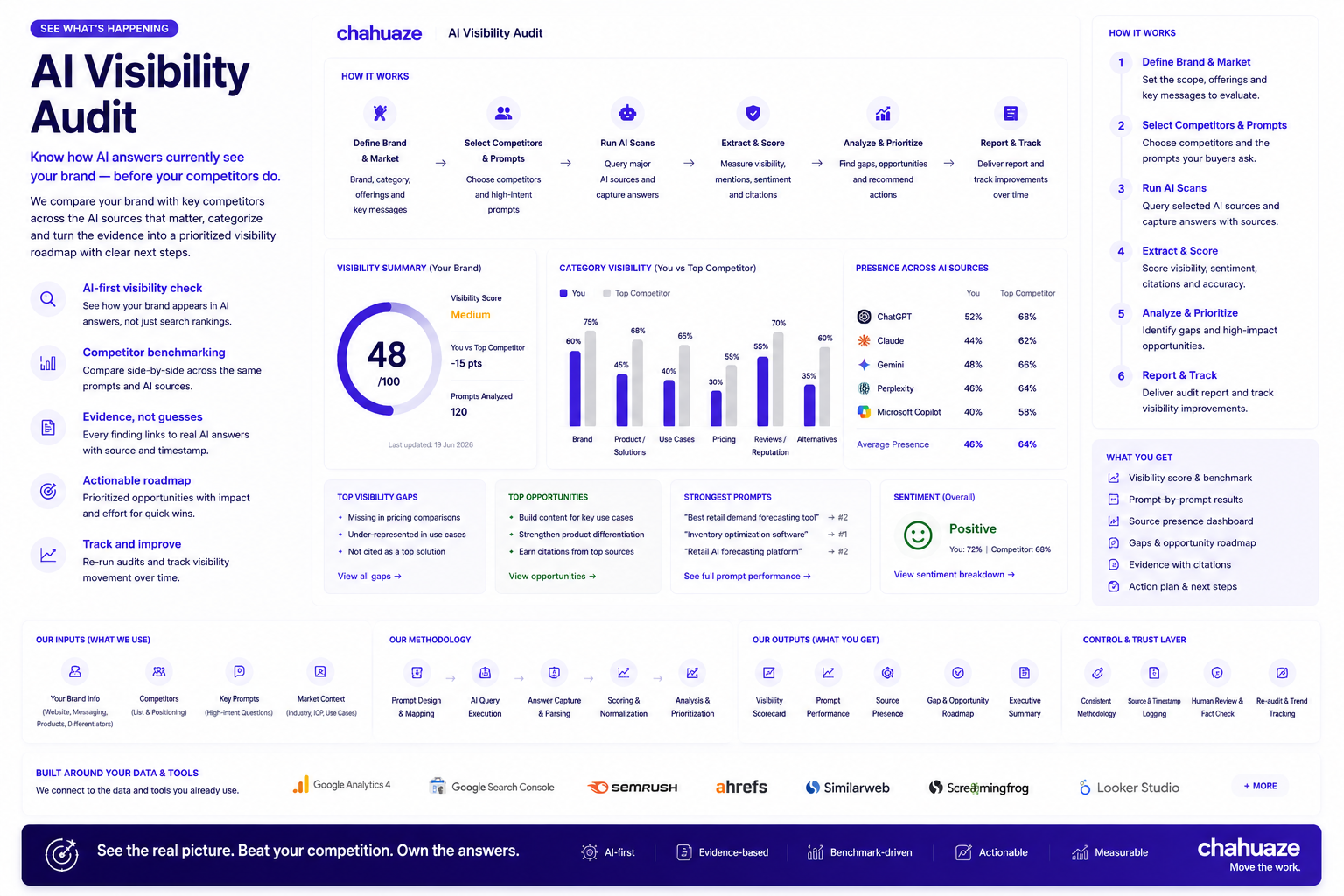
HOW IT WORKS
BRAND + MARKET + COMPETITORS → VISIBILITY BASELINE → RESPONSE / CITATION EVIDENCE → GAP MAP → PRIORITY BACKLOG
CONTROL / FALLBACK
Modeled visibility ≠ verified reach, market share or guaranteed ranking
Move beyond one-off prompt screenshots to a comparable saved view.
See who appears, how they are framed and which sources are repeatedly cited.
Focus on the gaps with the strongest commercial relevance and evidence.
HOW IT LOOKS IN YOUR BUSINESS +
FASHION & LUXURY
See how your brand appears around the categories, collections or product themes that matter.
Compare selected competitors, inspect how the brand is framed when it appears, identify repeatedly cited domains/pages, and surface weak or missing owned / editorial / third-party source coverage. The category, products, market and competitors come from the client — not a generic luxury prompt set.
FMCG / BEAUTY
Benchmark category and product visibility against meaningful FMCG competitors.
Use a defined market and product/category focus to compare AI responses, citations and source patterns, then identify the evidence and information gaps worth investigating first. AI visibility data does not prove product efficacy, regulatory truth, retailer availability or consumer demand.
Do you know how AI answers currently represent your brand?
AUDIT MY AI VISIBILITY08 / MAKE DECISIONS
Meeting Follow-Through
Important meetings should not end as private memory.
Turn buyer, client, retailer, distributor and account conversations into a reviewed operating record with explicit decisions, named next actions, owners, dates, follow-up context and an accountable next step while the conversation is still fresh.
Not AI meeting notes. A reviewed record of what happens next.
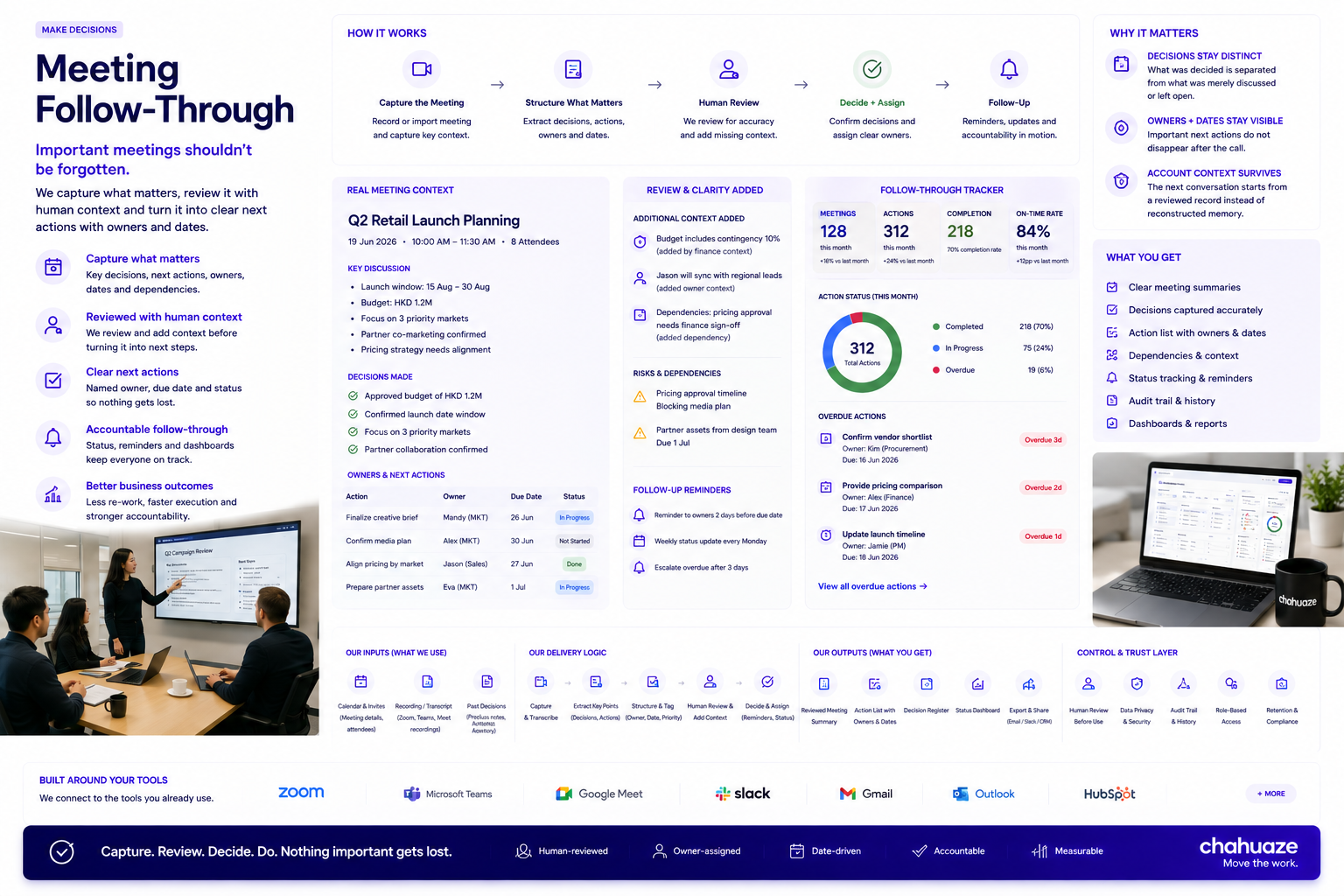
HOW IT WORKS
MEETING → CAPTURE → STRUCTURE WHAT MATTERS → HUMAN REVIEW → DECISIONS + ACTIONS → FOLLOW-UP
CONTROL / FALLBACK
Prices, dates, promises and sensitive commitments → HUMAN CHECK BEFORE USE
What was decided is separated from what was merely discussed or left open.
Important next actions do not disappear after the call.
The next conversation starts from a reviewed record instead of reconstructed memory.
HOW IT LOOKS IN YOUR BUSINESS +
FASHION & LUXURY
Carry buyer, showroom and partnership context into the next commercial move.
A buyer / wholesale / account meeting becomes reviewed decisions, product or assortment concerns, sample / order next steps, unresolved questions, owner and deadline where actually discussed. Sensitive luxury / partnership conversations use tighter sharing and human review.
FMCG / BEAUTY
Turn retailer, key-account and distributor meetings into accountable next actions.
Listing or launch requirements, SKU issues, dates, dependencies, unresolved questions and agreed next steps can become one reviewed record instead of living in different people’s notes. The system does not invent retailer requirements, launch dates or commitments.
Which important meetings keep losing decisions and follow-up?
REVIEW MY MEETING FOLLOW-THROUGH09 / MAKE DECISIONS
Async Review & Approval
Review the work. Skip the meeting.
Give every reviewer the same walkthrough, collect timestamped feedback on the exact visual moment, separate blocking from non-blocking issues, and let one named decision owner close the cycle clearly with APPROVED or REVISE.
One version. Precise feedback. One clear closeout.
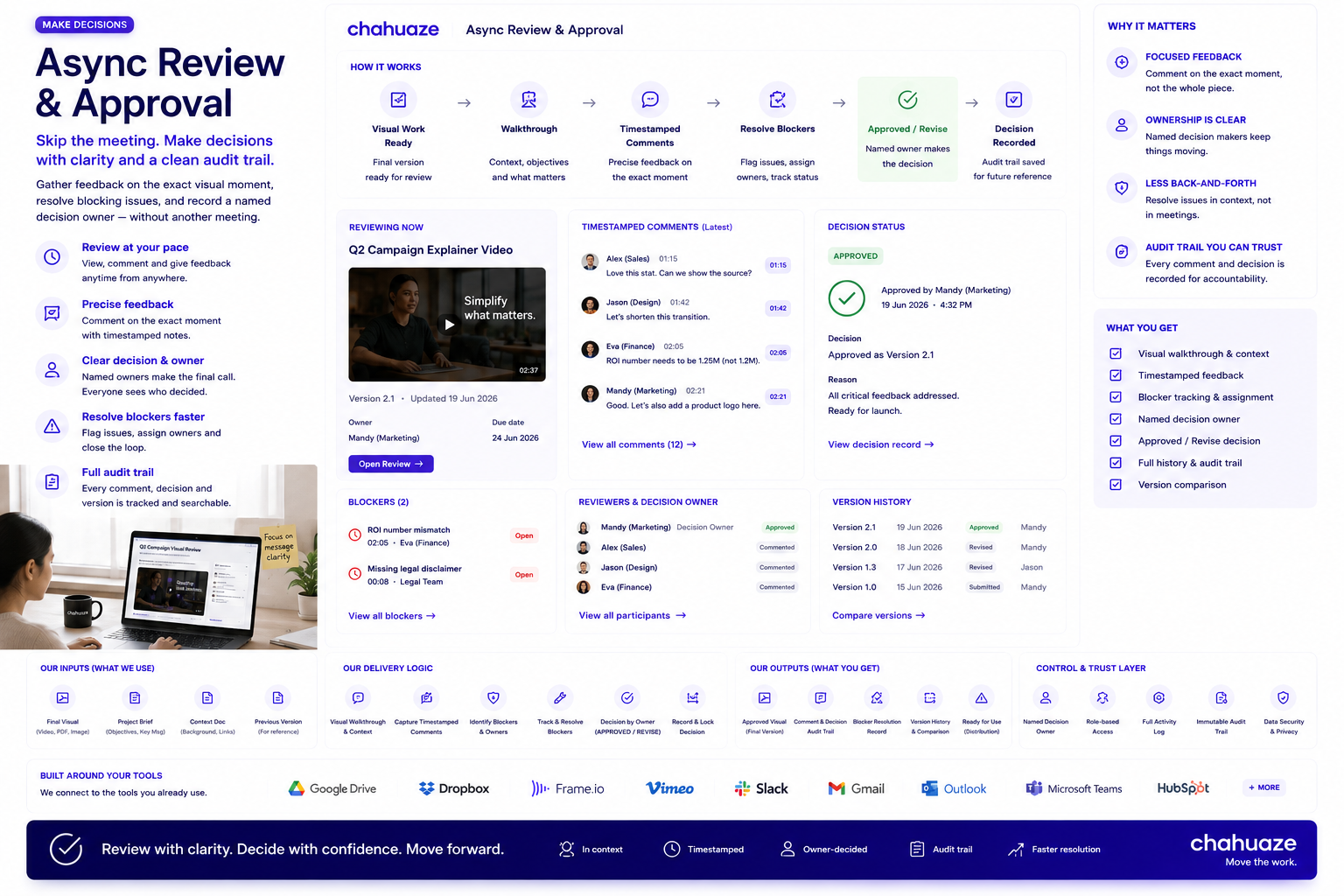
HOW IT WORKS
VISUAL WORK → WALKTHROUGH → TIMESTAMPED COMMENTS → RESOLVE BLOCKERS → APPROVED / REVISE
CONTROL / FALLBACK
Brand / legal / commercial authority → NAMED HUMAN DECISION OWNER
The creator explains once and reviewers respond when they are ready.
Comments attach to the exact visual moment instead of floating around in chat.
Everyone knows which version was reviewed and who closed the decision.
HOW IT LOOKS IN YOUR BUSINESS +
FASHION & LUXURY
Review PDPs, campaigns, localized assets and buyer-facing visuals without another calendar round.
A creator explains the exact version once → reviewers comment on the precise visual moment → blockers are resolved → one named owner closes APPROVED or REVISE. Useful for PDP / ecommerce, campaign / key visual, localized adaptation and screen-visible buyer / portal reviews.
FMCG / BEAUTY
Review packaging, launch assets, retailer presentations and digital campaign work on the exact version.
Stakeholders see the same walkthrough, leave feedback at the precise moment, and close the review without another meeting when screen-visible context is sufficient. Physical pack proof, regulatory approval and print sign-off are separate specialist processes.
Still scheduling meetings just to review the same screen?
REVIEW MY APPROVAL CYCLE10 / MAKE DECISIONS
Prototype Before Build
Click it before you build it.
Turn one real brief, user story or unresolved digital journey into a clickable target your team can inspect, test, challenge and approve before design and engineering commit to the expensive work.
Make “done” visible before the expensive work starts.
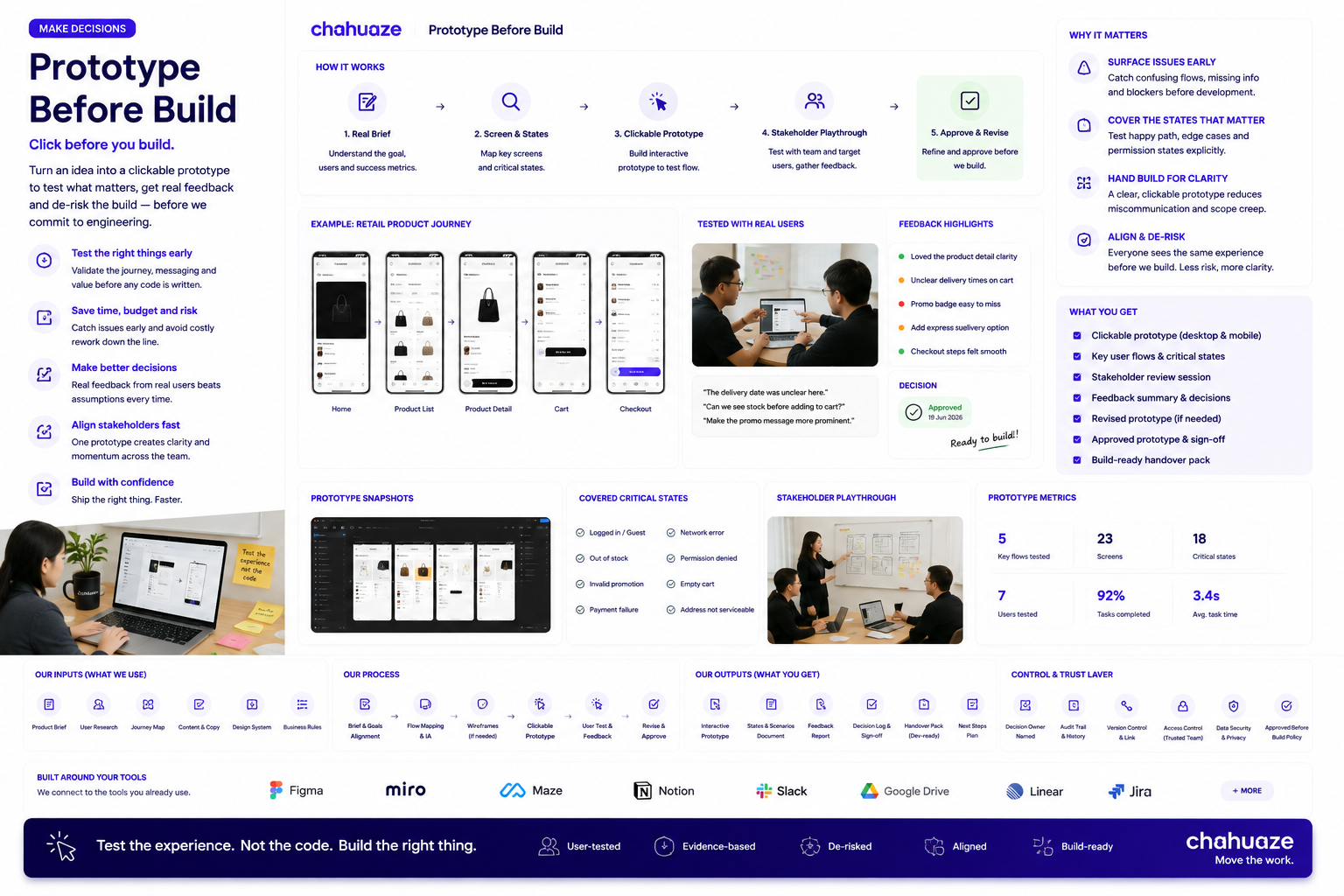
HOW IT WORKS
REAL BRIEF → 3–7 SCREENS / STATES → CLICKABLE PROTOTYPE → STAKEHOLDER PLAY-THROUGH → REVISE → APPROVED TARGET
CONTROL / FALLBACK
Prototype ≠ production application
Stakeholders can click the proposed experience instead of agreeing vaguely in slides.
Success, error, empty, loading and permission states can be made explicit where material.
The approved prototype and build boundary reduce ambiguity before implementation.
HOW IT LOOKS IN YOUR BUSINESS +
FASHION & LUXURY
Make buyer, staff or client journeys tangible before a portal or site is built.
Use a real wholesale request, sample / showroom journey, product-discovery flow, client portal or other verified business problem → make the critical screens / states clickable → expose disagreements → approve the target before build. Luxury VIP / member or clienteling examples only apply when the client actually has that real use case.
FMCG / BEAUTY
Validate retailer, sampling, product-education or loyalty journeys before implementation.
Turn one real FMCG / Beauty digital journey into a clickable target so commercial, brand and ecommerce teams can agree the critical states and decisions before build. The prototype does not prove retailer adoption, consumer demand, regulatory correctness or live backend behaviour.
About to build before everyone agrees what “done” looks like?
VALIDATE BEFORE BUILDHOW WE WORK
Show us the broken moment.
01
Find the friction.
One real recurring business moment, not a vague automation wish.
02
Define the working state.
What must exist, what changes, who owns the exception and what counts as acceptance.
03
Build and test.
Use the appropriate workflow, platform or proof without making technology the story.
04
Hand over the operating state.
A visible result, review path, boundary and next action your team can actually use.
BUSINESS SYSTEM FIT CHECK
Bring us one real business friction.
We’ll identify whether it fits one of these bounded systems, what must already exist, and what a useful working output should look like.
Start the conversation ↗